Department of Classics and Ancient Mediterranean Studies,
Pennsylvania State University


Study Abroad in Egypt
Keywords: Ancient Egypt, Giza Pyramids, Valley of the Kings, Luxor Temple, Karnak Temple, Egyptian history, archaeology, Saqqara Step Pyramid, Fayum, Aswan granite quarry, Abu Simbel, Nubian villages
Spend three unforgettable weeks tracing five thousand years of history across Egypt's most iconic landscapes, from the Great Pyramids of Giza to the temples of Luxor and the granite quarries of Aswan. This immersive study abroad program moves beyond the textbook, bringing ancient Egyptian political history, imperialism, and social life to life on the very ground where it unfolded.
Students climb the Giza plateau at dawn, descend into royal tombs in the Valley of the Kings, and stand before the colossal facades of Ramesses II's Abu Simbel temples. Along the way, the program probes questions that go far beyond monuments: how pharaohs built and rewrote their own legacies, how class and gender shaped daily life for royalty and commoners alike, and how modern narratives about ancient Egypt have themselves been constructed, contested, and revised.
Sites span Cairo, Giza, Saqqara, Alexandria, Dahshur, the Faiyum, Luxor, Abydos, Dendera, and Aswan, weaving together pyramids, temples, tombs, and quarries into a single continuous story of power, belief, and everyday life. Along the way, students also encounter Egypt's living heritage, from Coptic Cairo to Nubian villages, connecting the ancient past to the country's vibrant present.
01
The Giza Plateau: Pyramids, the Sphinx, and the Grand Egyptian Museum

At dawn, students will visit the Giza plateau to marvel at the iconic Pyramids and Sphinx, iconic symbols of Egypt’s architectural mastery and imperial might. Discussions will delve into the construction methods, symbolic importance, and the role these structures played in ancient Egyptian statecraft and religion. The visit to Khufu’s Solar Boat Museum will highlight ancient Egypt’s advanced maritime technology and the religious significance of the solar boat, emphasizing its role in the pharaoh’s afterlife journey.
The afternoon session at the Grand Egyptian Museum (GEM) will provide a comprehensive view of Egypt’s extensive history, from the prehistoric period to the Greco-Roman era. Through interactive exhibits and diverse collections, students will explore Egypt’s cultural and historical evolution, gaining insights into the complexity of its civilization. This experience will enrich their understanding of ancient Egyptian achievements in art, governance, and societal organization, offering a well-rounded perspective on the empire’s legacy.
02
Saqqara: Djoser's Step Pyramid, Elite Mastabas, and the Serapeum
At Saqqara, students will immerse themselves in the evolution of ancient Egyptian mortuary architecture and state development. The day begins with the Step Pyramid of Djoser, Egypt’s earliest colossal stone monument, where discussions will explore the pyramid’s innovative design and its role in the emerging concept of divine kingship. The nearby Pyramid of Unas, adorned with Pyramid Texts, offers further insight into the religious and funerary transformations of the Old Kingdom.
Exploring elite tombs, such as those of Horemheb and Maya, offers a perspective on the administrative and personal aspects of New Kingdom society. These tombs, with their detailed reliefs and inscriptions, shed light on the roles and daily lives of high-ranking officials, providing a nuanced understanding of the period’s social and governmental structure.
Next, the tour of the Serapeum, the burial site of the sacred Apis bulls, will reveal the blend of Greek and Egyptian religious practices and its significance in the Ptolemaic period, highlighting the continuity and adaptation of religious beliefs.

03

Alexandria: the Light House, the Library, and the Serapeum
Venturing north to Egypt's Mediterranean coast, students visit Alexandria, a beacon of Hellenistic culture and scholarship. Here, students will visit the sites of the ancient Lighthouse and the legendary Library, discussing their roles in knowledge preservation and cultural exchange. The Serapeum in Alexandria, dedicated to the syncretic deity Serapis, further illustrates the fusion of Greek and Egyptian religious practices. These visits will highlight Alexandria’s strategic importance in the Mediterranean, its cultural diversity, and its enduring legacy as a center of learning and innovation in the ancient world. Through these experiences, students will gain a comprehensive understanding of the cross-cultural interactions and historical developments that characterized these influential cities.
04
Visiting the Sacred Sanctuaries of Amun: Karnak and Luxor Temples
The day’s schedule allows for an in-depth exploration of two of Luxor’s most iconic sites. The morning will be dedicated to Karnak Temple, a sprawling complex that represents the zenith of ancient Egyptian temple architecture. Students will walk through its vast array of chapels, obelisks, and sacred lakes, discussing the various construction phases that span over two millennia and reflect the contributions of numerous pharaohs. The focus will be on understanding how the temple served as a political power base and a spiritual center, hosting significant religious ceremonies that reinforced the divine legitimacy of the rulers.
In the evening, the journey continues to Luxor Temple, an exquisite monument that showcases the accumulation of architectural and artistic styles over centuries. This visit will emphasize the temple’s historical layers, providing a concrete example of how successive rulers modified the structure to suit their ideological and political needs. Discussions will delve into the processes of historical editing and erasure, where newer narratives were superimposed on older ones, sometimes obliterating them, thereby reshaping the historical and cultural memory of ancient Egypt. This exploration of Karnak and Luxor Temples will offer students a nuanced perspective on the interplay between religion, politics, and history in ancient Egyptian civilization.

05

Valley of the Kings and Queens
The program will proceed to the Valley of the Kings, where students will explore the hidden tombs of New Kingdom pharaohs, delving into the advanced burial practices, religious beliefs, and artistic achievements of the period. This visit will facilitate discussions on the significance of tomb construction, decoration, and the practices of royal burials, providing insights into the afterlife beliefs and cultural values of the New Kingdom.
The exploration continues as students delve into the Valley of the Queens, where the tomb of Nefertari presents a masterclass in ancient Egyptian tomb artistry, showcasing vibrant paintings and intricate hieroglyphs that narrate royal and divine narratives. This visit underlines the sophistication of New Kingdom burial customs and the high status accorded to queens in the royal hierarchy.
06
The Tombs of Nobels and Royal Workmen's Village
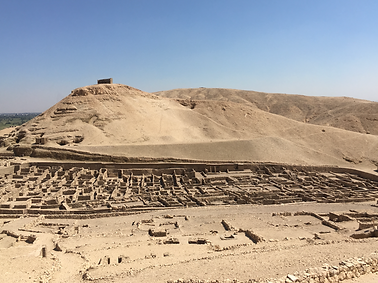
Visiting the Tombs of the Nobles and the Workmen’s Village in Deir el-Medina offers an exceptional insight into the social hierarchy and daily activities of Theban society. The tombs of the Nobles, with their elaborate decorations and inscriptions, shed light on the lives of the elite, their roles in the administration, and their relationship with the pharaohs. These sites illustrate the high status and wealth of ancient Egypt’s upper class, as well as their contributions to state and religious affairs.
In contrast, the Workmen’s Village provides a rare glimpse into the lives of the laborers who built and decorated the royal tombs. This site, one of the best-preserved ancient worker communities, reveals much about the organization of labor, the skill and artistry of the craftsmen, and the communal and familial aspects of their lives. Exploring the village’s homes, communal spaces, and artifacts offers a tangible connection to the workers’ experiences, highlighting the stark differences in living conditions, social status, and opportunities compared to the elite.
07

Paying Tribute to Osiris and Hathor: Abydos and Dendera
The journey to Abydos provides students with a profound insight into Egypt’s religious and architectural evolution. Seti I’s temple, housing the Abydos King List, is a crucial site for understanding historical continuity and royal ideology in ancient Egypt. This list, etched on the temple walls, enumerates many of Egypt’s dynastic rulers, offering a unique resource for studying the pharaonic legacy and the selective memory of history. The adjacent Osireion, with its subterranean construction, allows students to explore the mythical and ritualistic aspects of Osiris, god of the afterlife, delving into the religious underpinnings that shaped ancient Egyptian civilization.
Transitioning to Dendera, the group will explore the Temple of Hathor, a beacon of enduring religious tradition and artistic excellence. This temple, with its well-preserved reliefs and architecture, showcases the continuous development of temple art and religious practice. Students will observe firsthand the intricacies of the temple’s iconography and architectural design, reflecting on the ways in which these elements were adapted over centuries to maintain cultural and religious continuity.
08
Aswan and Elephantine: Egypt's Southern Frontier
The examination of elite cemeteries on Aswan’s West Bank offers students an invaluable insight into the provincial burial customs, art, and architecture of the Old Kingdom period. This exploration will shed light on the aesthetic preferences and funerary practices distinct to this region, contrasting with the royal and noble tombs found in Memphis. Through studying the tombs of local officials (Mekhu and Sabni, Harkhuf, Papynakht, Sarenput I, and Sarenput II), many of whom led expeditions to Nubia and oversaw trade and cultural exchanges, students will gain a deeper understanding of the socio-political and economic interactions between Egypt and Nubia.
At Elephantine Island, students will immerse themselves in a site that serves as a microcosm of Egypt’s extensive history, exploring archaeological layers spanning from pre-dynastic to Roman periods. They will investigate the island’s temples, dedicated to Khnum and other cataract deities, which highlight the religious significance of this borderland region. The examination of Nilometers, used to measure the Nile’s flood levels, will provide insights into ancient Egyptian engineering and economic planning. The sanctuary of Heqaib and other archaeological remains will further reveal the complex social and religious life of the area.
